What is inner focus?

Inner focus is the ability to direct and sustain one’s attention on the present moment, thoughts, emotions, or a specific task without being easily distracted by external factors. It involves turning inward, quieting the mind, and cultivating a state of heightened awareness and concentration. Maintaining inner focus is crucial for various aspects of life, including productivity, creativity, emotional well-being, and personal growth.
1

To maintain inner focus, practising self-awareness and developing skills such as mindfulness and meditation are important. Mindfulness allows individuals to observe their thoughts and sensations non-judgmentally, helping to anchor attention in the present moment. Regular meditation sessions enable individuals to train their minds to be more resilient to distractions and increase their capacity to sustain focus.

Creating an environment that minimises external distractions can also support inner focus. Removing clutter, turning off notifications, and finding a quiet space can help create a conducive atmosphere for concentration. Additionally, setting clear intentions, prioritising tasks, and managing time effectively contribute to maintaining inner focus.

Practising self-discipline, taking regular breaks, and engaging in self-care activities are vital to prevent mental fatigue and restoring inner focus. By staying present and accepting the current moment, individuals can reduce unnecessary worry and rumination, allowing them to fully immerse themselves in the task at hand.

Ultimately, maintaining inner focus requires commitment, patience, and consistent practice. Through conscious effort and a nurturing mindset, individuals can strengthen their ability to maintain their internal compass, leading to enhanced productivity, well-being, and personal development.

Joint my group on LinkedIn: https://www.linkedin.com/groups/12850186/
A little introduction

Five years ago, my family and I decided to start a new chapter in our lives and moved to Scotland. I began to work with independent clients in 2021 as a business and life coach. From April 2023, I’ve become a Gallup-Certified Cliftonstrengths Coach to support my clients to shift their attention from their weaknesses to their Talents and nurture them into Strengths. Previously, I worked for more than ten years in management and administrative positions in higher education and governmental organisations. And after a career change, I worked as a massage therapist for seven years in a spa, hotel and in my own business.

Add a heading-3
My CliftonStrengths top 5 are Empathy, Connectedness, Input, Belief, Responsibility. But what does it mean? It means I am an intuitive, counselling, inquisitive, dependable believer. During the sessions we are focusing on you and your ways, your solutions. We talk about your natural Talents and the investments you can take to transform them into Strengths. We talk about your weaknesses and blind spots that sabotage your success but with awareness you will be able to Name, Claim and Aim your Strengths and utilise them to thrive.

“Everybody needs a coach – someone to help them understand their talents and strengths, navigate their challenges, move forward when they are stuck, and reach their greatest potential.”

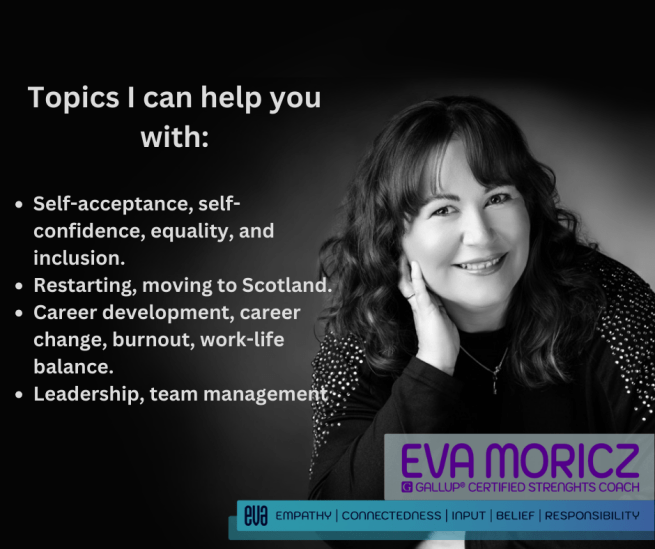
Topics I can help you with:

– I have been visually impaired since I was born; I also wrote my dissertation on equality law, so one of my main areas is self-acceptance, self-confidence, equality, and inclusion.

– Changing career paths, places of residence, and lifestyles could be challenging, but small steps and consistency can keep us on track. That is why restarting, moving to the UK, career development, career change, burnout, work-life balance, and starting a business are my other important areas.

The language of the sessions can be English or Hungarian.

In my program, I work with the CliftonStrengths Assessment by Gallup, which outlines your top talents, while your report features definitions of each of those talents that are specific to you. Discovering and owning your Strengths help you to understand yourself better and grow in the way that is the most effective and best for you. Learn more here

What is coaching?

Coaching is an ongoing, co-active professional relationship designed to guide you in creating a successful path. Each session has its own purpose, which supports you to look at your goal from a new perspective, map out the possibilities and finally take steps to achieve those goals.

Why choose me?

  • Because I experienced change in many levels of my life and have Empathy and Connectedness as my top strengths. With their help I have an open mind and an open heart to listen and help you through your journey.
  • We need to choose each other as equal partners. Please look around here, read my blog, or follow me on Facebook, Instagram or LinkedIn. If you feel that my words resonate with you please get in touch.
  • I’m a reliable, dedicated person, you can count on me. If I agree that we can work together this means I believe in you and I will work hard with you to achieve your goals. Have a look at the Testimonials page where you can read others’ experiences.

Be closer to your goal today than you were yesterday!

Book your appointment now here

Why should we talk about our weaknesses Part 4 – To have feedback 

Receiving feedback is a valuable aspect of personal and professional growth. When you talk about your weaknesses and open yourself up to feedback from others, you invite a fresh perspective that can help you identify blind spots and areas of improvement that you may not have been aware of.

One of the key benefits of receiving feedback is gaining insights into blind spots. Blindspots are aspects of ourselves that we are unaware of or overlook. They can include biases, patterns of behaviour, or blind spots in our thinking. Feedback from others can provide valuable information about these blindspots, offering a different viewpoint and shedding light on areas that require attention.

Often, we have limited self-awareness, and our perception may be influenced by personal biases. Feedback from others acts as a reality check, allowing us to see ourselves more accurately. It helps to fill in the gaps in our understanding and highlights areas where we may need to make changes or improvements. By receiving feedback, we become more self-aware and gain a deeper understanding of how our weaknesses impact ourselves and others.

Constructive feedback can also provide specific areas for improvement that we may not have considered on our own. Others may observe behaviours, skills, or attitudes that hinder our growth or effectiveness. Their insights can be invaluable in guiding us towards necessary changes or development. By actively seeking feedback and being receptive to it, we open ourselves up to new possibilities for growth and improvement.

However, receiving feedback can sometimes be challenging. It can be uncomfortable to hear about our weaknesses or areas where we fall short. It is important to approach feedback with an open mind and a growth-oriented mindset. Instead of becoming defensive or dismissing the feedback, consider it as an opportunity for growth and self-improvement. Embrace feedback as a gift that helps you uncover blindspots and enhance your understanding of yourself.

No alt text provided for this image

To make the most of feedback, actively seek it from trusted sources who have a genuine interest in your growth and well-being. Look for individuals who can provide honest and constructive feedback, such as mentors, colleagues, or friends who have your best interests at heart. Creating a safe environment where feedback is welcomed and valued is essential for a healthy feedback exchange.

Receiving feedback also involves active listening and effective communication. Listen attentively to the feedback, seeking clarification if needed. Ask follow-up questions to gain a deeper understanding of the feedback provider’s perspective. It is important to acknowledge and appreciate the feedback, even if it is uncomfortable, as it demonstrates your openness and willingness to grow.

In conclusion, receiving feedback is a valuable process that helps us identify blindspots and areas of improvement. By talking about our weaknesses and being open to feedback, we gain valuable insights and perspectives that may not have been apparent to us. Receiving feedback requires a growth mindset, active listening, and effective communication. Embrace feedback as an opportunity for personal and professional growth, as it can guide us towards positive change and development.

Why should we talk about our weaknesses Part 3 – To build trust

Sharing your weaknesses with others can be a powerful way to build trust and foster deeper connections. When you open up about your vulnerabilities, you demonstrate a level of honesty and authenticity that can create a safe space for others to do the same. This can lead to more meaningful and genuine relationships, both personally and professionally.

One of the primary benefits of sharing your weaknesses is that it can help to break down barriers between people. When you are open and honest about your own struggles, you demonstrate a willingness to be vulnerable and transparent with others. This can create a sense of mutual understanding and respect, which is essential to building trust.

Sharing your weaknesses can also create a sense of empathy and compassion. When you are open about your own struggles, you are better able to understand and empathize with the struggles of others. This can help to create a more supportive and caring environment where people feel comfortable seeking help and support when they need it.

Another benefit of sharing your weaknesses is that it can help to create a more inclusive and diverse environment. When people feel comfortable sharing their vulnerabilities, it can help to break down stereotypes and preconceptions. This can create a more open and accepting culture where people feel valued for their unique experiences and perspectives.

No alt text provided for this image

Sharing your weaknesses can also be a powerful tool for leadership. When leaders are open and transparent about their own struggles, it can create a sense of trust and respect with their team. This can help to build a strong and cohesive team where everyone feels valued and supported.

It is important to note that sharing your weaknesses is not always easy. It can be difficult to admit to your own vulnerabilities, especially in a culture that values strength and success. However, by being open and honest about your struggles, you demonstrate a level of courage and resilience that can inspire others.

When sharing your weaknesses, it is important to do so in a safe and supportive environment. Choose people whom you trust and who have demonstrated a level of empathy and understanding in the past. It can also be helpful to start with smaller disclosures and build up to more significant ones over time.

In conclusion, sharing your weaknesses with others can be a powerful tool for building trust and fostering deeper connections. By demonstrating a willingness to be vulnerable and transparent, you create a safe space for others to do the same. This can lead to more meaningful and authentic relationships, both personally and professionally. Sharing your weaknesses can also create a sense of empathy and compassion, build more inclusive and diverse environments, and be a powerful tool for leadership. While it may not always be easy, sharing your weaknesses is an essential part of building trust and creating more meaningful relationships with others.

Why should we talk about our weaknesses Part 2 – To overcome shame

Continuing last week’s thoughts about why we should begin talking about weaknesses and I shared 5 tips about the topic.

My second point was about admitting our weaknesses can help us to overcome shame. But how?

Admitting your weaknesses can be daunting, often bringing up feelings of vulnerability and shame. It can be easy to feel like your weaknesses make you less of a person, leading to self-doubt and negative self-talk. However, it is important to remember that everyone has weaknesses, and acknowledging them can be the first step in overcoming them.

No alt text provided for this image
Woman hides her face with her hands

Talking about your weaknesses with others can be a powerful tool in overcoming shame. When you open up to someone and share your vulnerabilities, you allow yourself to be seen and heard. This can help reduce feelings of isolation and create a sense of connection. By sharing your weaknesses, you may find that others can relate and share their own struggles, leading to a sense of shared humanity.

In addition to the support of others, it is key to work on developing self-compassion. This involves treating yourself with kindness and understanding rather than harsh self-judgment. Recognising that everyone makes mistakes and weaknesses is a natural part of being human. By practising self-compassion, you can develop a more positive self-image and reduce feelings of shame.

Another way to overcome shame is to reframe your perspective on weaknesses. Instead of viewing them as negative or shameful, try to see them as opportunities for growth and learning. By acknowledging your weaknesses, you are opening yourself up to the possibility of improvement and personal development.

Challenging negative self-talk and replacing it with positive affirmations can also be helpful. Instead of focusing on what you cannot do, focus on your strengths and what you can do. Remind yourself of your accomplishments and the progress you have made rather than dwelling on your weaknesses.

When working on overcoming shame, it is essential to remember that it is a process. It may take time to develop self-compassion and a positive self-image. Be patient with yourself and focus on making progress rather than perfection. Celebrate small victories and recognise that each step forward is a step in the right direction.

No alt text provided for this image

In conclusion, admitting your weaknesses can be a difficult and vulnerable process. However, by discussing your weaknesses, you can overcome shame and develop a more positive self-image. Surrounding yourself with supportive people, practising self-compassion, reframing your perspective, and challenging negative self-talk are all effective ways to work on overcoming shame. Remember that it is a process and be patient with yourself as you work towards a more positive and accepting relationship with your weaknesses.

Why should we talk about our weaknesses Part 1 – Increase self-awareness

Increased self-awareness is one of the key benefits of talking about your weaknesses. When you take the time to reflect on your behaviour, personality, and attitudes, you gain a deeper understanding of yourself. This awareness can be used to identify areas that may need improvement, including your weaknesses.

When you talk about your weaknesses with others, you open yourself to feedback and suggestions. This feedback can be invaluable in helping you identify areas that may need work. For example, you may be unaware that your communication style is overly aggressive or that your procrastination hinders your productivity. By talking about your weaknesses, others can provide insights that help you see yourself in a different light.

tree-of-life-i1d-prints.jpg

Once you have identified your weaknesses, you can develop a plan to address them. This plan can include specific actions or behaviours you need to change and resources or support that can help you in your journey. You may struggle with time management, so you may need to create a schedule and prioritize your tasks. You may also need to enlist the help of a coach or mentor who can hold you accountable and provide guidance.

The process of addressing your weaknesses can be challenging, but it can also be rewarding. As you work on improving yourself, you may feel more confident and capable. You may also notice improvements in your relationships, career, or personal life. By becoming more self-aware and addressing your weaknesses, you can become a better version of yourself.

One of the keys to developing self-awareness is, to be honest with yourself and others. This requires a willingness to be vulnerable and admit to your shortcomings. It can be challenging to talk about your weaknesses, especially if you are used to projecting a certain image to others. However, being honest about your weaknesses can help you connect with others on a deeper level and create more authentic relationships.

nb_EMoricz-5246_1200

Another important aspect of developing self-awareness is practising mindfulness. This involves being present at the moment and observing your thoughts, feelings, and behaviours without judgment. Mindfulness can help you become more aware of your strengths and weaknesses, as well as the impact of your actions on others.

In addition to talking about your weaknesses with others, journaling or reflecting on your thoughts and feelings can be helpful. Writing down your reviews can help you gain clarity and perspective on your situation. It can also help you track your progress as you work on addressing your weaknesses.

Finally, it is essential to remember that self-awareness is a lifelong journey. You will likely encounter new challenges and weaknesses throughout your life, and it is important to approach them with a growth mindset. This means being open to feedback, learning from your mistakes, and embracing challenges as opportunities for growth.

In conclusion, talking about your weaknesses can be a powerful tool for increasing self-awareness and personal growth. By being honest with yourself and others, practising mindfulness, and developing a plan to address your weaknesses, you can become a better version of yourself. Remember to approach your weaknesses with a gentle mindset and be patient with yourself as you navigate this journey of self-discovery.

Theme of the month: Blind spots and weaknesses

The theme of the month in May is our weaknesses and blind spots. But why should we start talking about them?
Here are 5 tips to begin with.
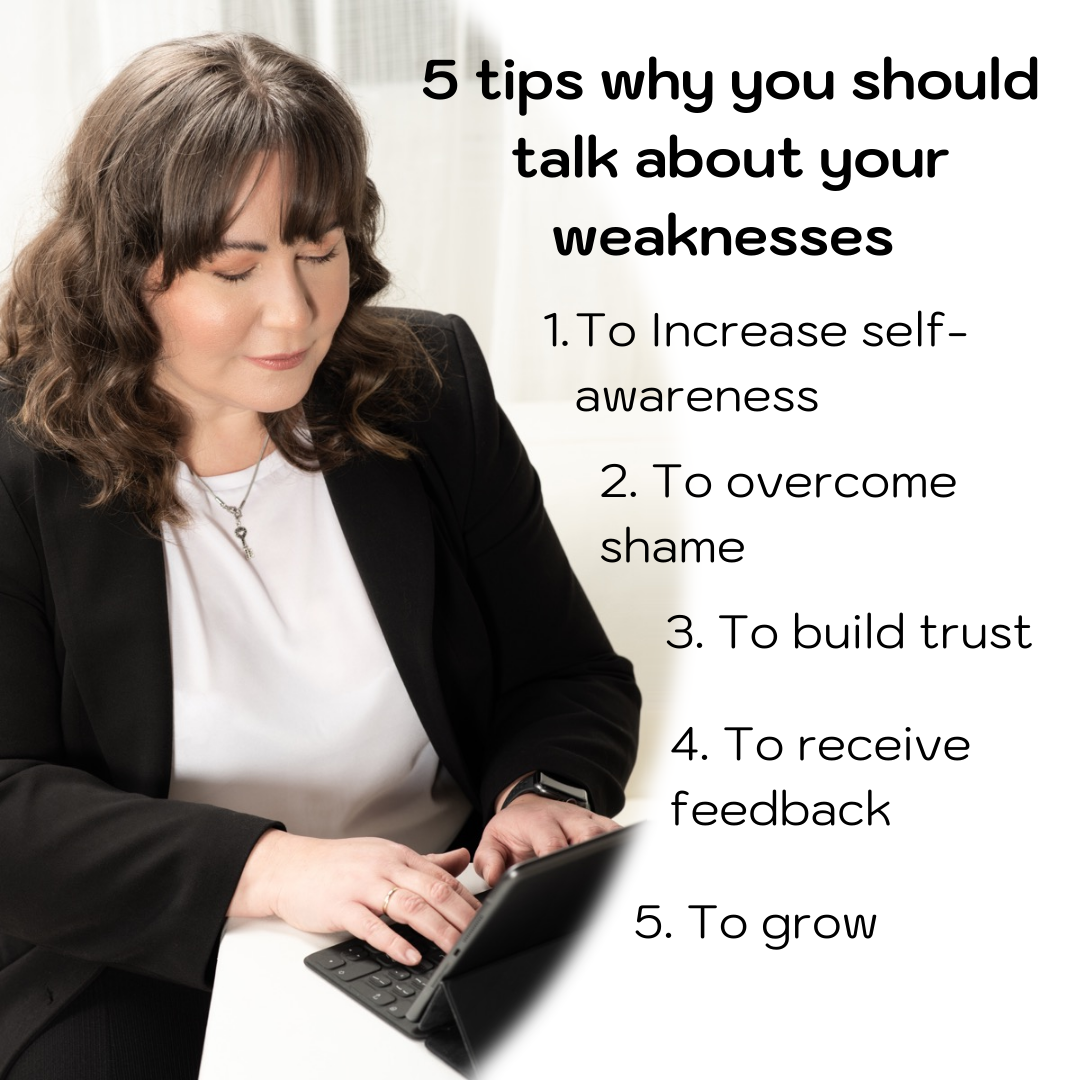
5 tips why you should talk about your weaknesses
1. Increased Self-Awareness: Talking about your weaknesses can help you identify areas of your personality or behaviour needing improvement. This self-awareness can help you develop a plan to address your weaknesses and become a better version of yourself.
 
2. Overcoming Shame: Admitting your weaknesses can be difficult, as it may make you feel vulnerable or ashamed. However, by discussing your weaknesses, you can overcome these negative feelings and develop a more positive self-image.
 
3. Building Trust: Sharing your weaknesses with others can help build trust and create a deeper connection with them. When you open up about your vulnerabilities, others may feel more comfortable doing the same, leading to more authentic and meaningful relationships.
 
4. Receiving Feedback: When you talk about your weaknesses, you may receive constructive feedback from others. This feedback can help you identify blind spots or areas of improvement that you may not have considered otherwise.
 
5. Personal Growth: You can create a roadmap for personal growth and development by talking about your weaknesses. This process can help you set goals, track progress, and ultimately become the best version of yourself.
 
If you want to learn more about this, please join: 
 
#business #businesstips #businesswoman #businessowner #businesscoach #businessgrowth #businessowners #businesscoaching #parentslife #scotland #lifecoachuk #careerdevelopment #cliftonstrengths

Midlife crisis

The term is becoming more and more well-known and widespread. However, as in many cases, we come across many conflicting theories. The concept of the midlife crisis was developed by Elliott Jaques in 1965, and he applied it primarily to men. In the case of women, menopause, which indicates a change in biological processes, is a much clearer milestone, as it marks the end of the period of the ability to conceive. Unfortunately, women’s physical changes were blamed for men’s mood swings and, in many cases, even for leaving their entire structured existence and family.
 
pexels-photo-4098224
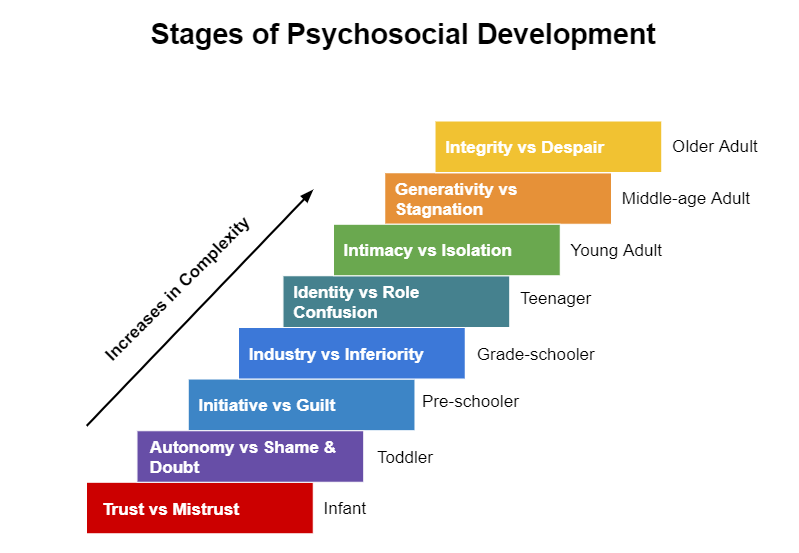
Another significant person is the famous psychologist Erik Erikson, well known for his life stage theory about going through 8 life stages. So, our development does not end with the end of adolescence, as was previously thought.
 
In the first stage, children bond with their parents deeply through attachment. In a healthy environment, babies develop a deep trust, and they’ll be able to build healthy, strong relationships in the future. This is the first year of their lives.
 
The second stage is the second year, when children start to develop their autonomy.
 
The third stage is the period between the age of 3-5 when the ability to take the initiative develops, and the sense of guilt and doubt appears. Children are able to create their rules and games.
 
The fourth period lasts from the age of six until puberty. Children understand how things function in this developmental period and the importance of organisational tasks.
stages of psychosocial development
The fifth period is the first period of crisis, the age of adolescence between the age of 12-16. This period brings confusion and physical and hormonal changes. Questioning parents’ control over them and setting boundaries is on one side. Meanwhile, relying the opinion of their peers on the other side. Most common questions: Who am I? What kind of person am I? Where do I belong?
 
The sixth period is young adulthood, about building our first serious relationship and ideas about what we want to do as a profession.
 
The seventh period is important for family formation and social and community cohesion. During these years, our family starts growing, our relationship with our partner is deeper, and we usually have achievements in our professional life as well. And around the age of 35-45 when people typically have a look at their milestones and achievements. Unfortunately, in Western societies, there is a massive expectation on individuals that they need to have children, a house, a car, high-paying job by this time. And at the same time, they also have their dreams and values they might put aside to achieve these pressured goals. The most frequently asked questions are: Who am I? What is the meaning of my life? Where am I? I have everything, so why am I not happy? At this point, most clients begin to deal with self-awareness and turn to themselves.
 
The eighth period is the period of fulfilment, the feeling of satisfaction with life, the conscious confrontation with death and the appearance of the associated fears.
 
Monthly group coaching event on this topic with anchoring strategies and solutions to overcome midlife crisis. 
 

Only 4 days

Happy Monday Everyone,

My name is Eva I’m a life and business coach, and I provide coaching for busy parents online. This month I’m launching a 3-week program for newcomers or those who lack confidence speaking in English. When I arrived here five years ago, I remember how my hand shook every time I had to make a phone call. The purpose of this workshop is to make this process easier for others. This first pilot workshop is only for six people to ensure a safe and supportive environment.

nb_EMoricz-5318_1200

If you know anyone who might benefit from this program, please share. I always reserve one space for someone who can’t afford coaching at the moment.

Dare to speak / Confidently in English Program

❓Are you a newcomer in Scotland and want to build a new home?

❓Do you speak English but lack the confidence to start a discussion?

❓Are you preparing for a job interview?

❓Would you like to boost your self-awareness and take action for your self-development?

❓Do you want to be more confident speaking English with your friends or colleagues?

❓Do you want to grow your comfort zone and make connections?

⁉️What if I tell you that you can practice it in a supportive, fun environment while receiving tips and tools about self-development and career growth?

If you say yes to any of these questions, you can grab your ticket and let’s get started.

https://www.eventbrite.co.uk/e/confidently-in-english-online-group-coaching-tickets-595220429327

Try something new – volunteering

This week I went to Thornton Rose RDA (Riding for the Disabled Association) in Rosewell. It was my first-time volunteering, and I had already learned many things. And most importantly, I met many lovely, welcoming people.As a horsey person, I love spending my time around these beautiful animals. Picture description (PD): a field in the sunshine I took in Rosewell this Wednesday. In the back of the field there are a line of trees. 

IMG_0186

Horses are very sensitive and intuitive. They reflect your emotional state to you. This was a comfort zone growing experience for me because I had to go to a place I’d never been before. However, I took a trial trip just to the stables to know which bus I needed to take, but instead of that, I didn’t know what to expect. Also, I didn’t have much experience working with horses. I spent some time around them in my childhood in camps where we had to groom them and mock the stables but these days, not much. PD: On the scanned picture there is a horse and a girl on the saddle and next to them there are another 6 girls, including me who wears sunglasses.

IMG_0188
What does RDA provide?
“Thornton Rose provides riding opportunities for people of all ages and disabilities to enjoy a safe, stimulating, therapeutic and recreational sport. The group was formed in 1984 under a previous name and established as Thornton Rose in 2004 when we relocated to Thornton Farm, Rosewell.
The group is a member of the Riding for the Disabled Association, where our vision is to improve the lives of people with disabilities through activities connected with horse riding.”

So, I spend there a few hours and helped where I could. The coaches and volunteers gave me instructions and small tours around the place and duties. However, it was bloody windy I enjoyed spending the day outdoors. I enjoyed every minute and will go again soon.

PD: on the second picture there is 10 reasons in small bubbles why you should volunteer this summer. In the circles the texts are: flexibility your time, your place; develop your skills; meet new people; try something new; enhance your CV; personal achievement; give back to society; gain a whole new perspective; make change happen; it’s fun.

Why is it worth volunteering?

  1. It is flexible. You work as much as you can or want. They will appreciate every minute you spend there, just be correct and honest.
  2. Meeting new people and making new connections increase our mental health.
  3. As a volunteer, you develop your skills. Learning new things is exciting and gives you good feedback that you are much more capable of than you think.
  4. In addition, you can put volunteering in your CV as a resourceful experience. And companies appreciate those who are willing to volunteer.
  5. You can try new things, something you’ve never done before. This is an adventure!

BANNER+(2)

  1. As a volunteer, you achieve things, and your work is appreciated. Remember, it’s not free. You give your precious time, which is your most crucial resource.
  2. Giving back to our community helps us to join in and be a real part of them.
  3. Helping others and experiencing their challenges will increase your empathy and understanding and give you a new perspective.
  4. We all (okay, most of us) want to make the world a better place to live in. Volunteering is a perfect place to start. You can find hundreds of charities that already have visions, programs, and strategies. You can choose any of them. Let’s make change happen.
  5. You can choose a role you are interested in administration, fundraising, event organising, helping around horses, and participating in sports events—so many options.
  6. You can find volunteering opportunities in Scotland, some of which are paid on the links below.

https://www.volunteerscotland.net

https://goodmoves.com/?gclid=Cj0KCQjwlPWgBhDHARIsAH2xdNez7f_DirtStmxgfuJH5S5TEpEEs4c4_wuBUa-_j6PI_2e2BmNaFMsaAucwEALw_wcB

  1. It’s fun! Spending time with something you enjoy, helping others, learning new things helps you develop a better mental state, grow your empathy and connect with your emotions.