Why should we talk about our weaknesses Part 1 – Increase self-awareness

Increased self-awareness is one of the key benefits of talking about your weaknesses. When you take the time to reflect on your behaviour, personality, and attitudes, you gain a deeper understanding of yourself. This awareness can be used to identify areas that may need improvement, including your weaknesses.

When you talk about your weaknesses with others, you open yourself to feedback and suggestions. This feedback can be invaluable in helping you identify areas that may need work. For example, you may be unaware that your communication style is overly aggressive or that your procrastination hinders your productivity. By talking about your weaknesses, others can provide insights that help you see yourself in a different light.

tree-of-life-i1d-prints.jpg

Once you have identified your weaknesses, you can develop a plan to address them. This plan can include specific actions or behaviours you need to change and resources or support that can help you in your journey. You may struggle with time management, so you may need to create a schedule and prioritize your tasks. You may also need to enlist the help of a coach or mentor who can hold you accountable and provide guidance.

The process of addressing your weaknesses can be challenging, but it can also be rewarding. As you work on improving yourself, you may feel more confident and capable. You may also notice improvements in your relationships, career, or personal life. By becoming more self-aware and addressing your weaknesses, you can become a better version of yourself.

One of the keys to developing self-awareness is, to be honest with yourself and others. This requires a willingness to be vulnerable and admit to your shortcomings. It can be challenging to talk about your weaknesses, especially if you are used to projecting a certain image to others. However, being honest about your weaknesses can help you connect with others on a deeper level and create more authentic relationships.

nb_EMoricz-5246_1200

Another important aspect of developing self-awareness is practising mindfulness. This involves being present at the moment and observing your thoughts, feelings, and behaviours without judgment. Mindfulness can help you become more aware of your strengths and weaknesses, as well as the impact of your actions on others.

In addition to talking about your weaknesses with others, journaling or reflecting on your thoughts and feelings can be helpful. Writing down your reviews can help you gain clarity and perspective on your situation. It can also help you track your progress as you work on addressing your weaknesses.

Finally, it is essential to remember that self-awareness is a lifelong journey. You will likely encounter new challenges and weaknesses throughout your life, and it is important to approach them with a growth mindset. This means being open to feedback, learning from your mistakes, and embracing challenges as opportunities for growth.

In conclusion, talking about your weaknesses can be a powerful tool for increasing self-awareness and personal growth. By being honest with yourself and others, practising mindfulness, and developing a plan to address your weaknesses, you can become a better version of yourself. Remember to approach your weaknesses with a gentle mindset and be patient with yourself as you navigate this journey of self-discovery.

Midlife crisis

The term is becoming more and more well-known and widespread. However, as in many cases, we come across many conflicting theories. The concept of the midlife crisis was developed by Elliott Jaques in 1965, and he applied it primarily to men. In the case of women, menopause, which indicates a change in biological processes, is a much clearer milestone, as it marks the end of the period of the ability to conceive. Unfortunately, women’s physical changes were blamed for men’s mood swings and, in many cases, even for leaving their entire structured existence and family.
 
pexels-photo-4098224
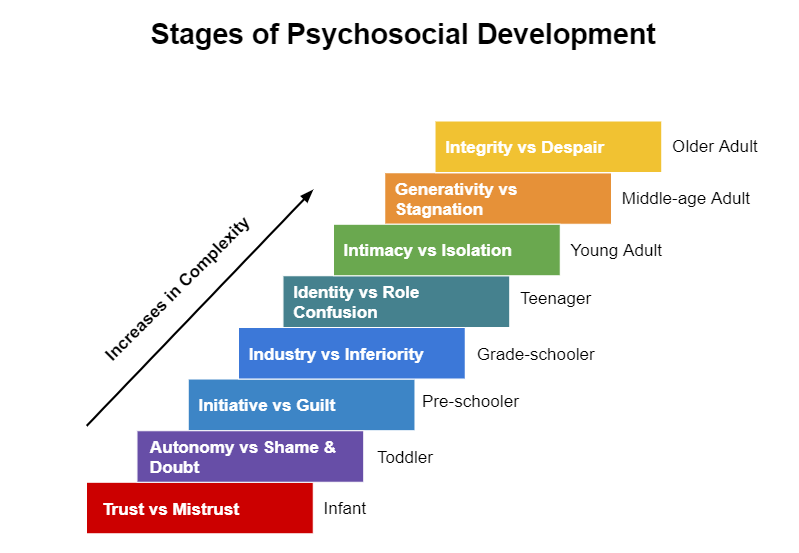
Another significant person is the famous psychologist Erik Erikson, well known for his life stage theory about going through 8 life stages. So, our development does not end with the end of adolescence, as was previously thought.
 
In the first stage, children bond with their parents deeply through attachment. In a healthy environment, babies develop a deep trust, and they’ll be able to build healthy, strong relationships in the future. This is the first year of their lives.
 
The second stage is the second year, when children start to develop their autonomy.
 
The third stage is the period between the age of 3-5 when the ability to take the initiative develops, and the sense of guilt and doubt appears. Children are able to create their rules and games.
 
The fourth period lasts from the age of six until puberty. Children understand how things function in this developmental period and the importance of organisational tasks.
stages of psychosocial development
The fifth period is the first period of crisis, the age of adolescence between the age of 12-16. This period brings confusion and physical and hormonal changes. Questioning parents’ control over them and setting boundaries is on one side. Meanwhile, relying the opinion of their peers on the other side. Most common questions: Who am I? What kind of person am I? Where do I belong?
 
The sixth period is young adulthood, about building our first serious relationship and ideas about what we want to do as a profession.
 
The seventh period is important for family formation and social and community cohesion. During these years, our family starts growing, our relationship with our partner is deeper, and we usually have achievements in our professional life as well. And around the age of 35-45 when people typically have a look at their milestones and achievements. Unfortunately, in Western societies, there is a massive expectation on individuals that they need to have children, a house, a car, high-paying job by this time. And at the same time, they also have their dreams and values they might put aside to achieve these pressured goals. The most frequently asked questions are: Who am I? What is the meaning of my life? Where am I? I have everything, so why am I not happy? At this point, most clients begin to deal with self-awareness and turn to themselves.
 
The eighth period is the period of fulfilment, the feeling of satisfaction with life, the conscious confrontation with death and the appearance of the associated fears.
 
Monthly group coaching event on this topic with anchoring strategies and solutions to overcome midlife crisis. 
 

Only 4 days

Happy Monday Everyone,

My name is Eva I’m a life and business coach, and I provide coaching for busy parents online. This month I’m launching a 3-week program for newcomers or those who lack confidence speaking in English. When I arrived here five years ago, I remember how my hand shook every time I had to make a phone call. The purpose of this workshop is to make this process easier for others. This first pilot workshop is only for six people to ensure a safe and supportive environment.

nb_EMoricz-5318_1200

If you know anyone who might benefit from this program, please share. I always reserve one space for someone who can’t afford coaching at the moment.

Dare to speak / Confidently in English Program

❓Are you a newcomer in Scotland and want to build a new home?

❓Do you speak English but lack the confidence to start a discussion?

❓Are you preparing for a job interview?

❓Would you like to boost your self-awareness and take action for your self-development?

❓Do you want to be more confident speaking English with your friends or colleagues?

❓Do you want to grow your comfort zone and make connections?

⁉️What if I tell you that you can practice it in a supportive, fun environment while receiving tips and tools about self-development and career growth?

If you say yes to any of these questions, you can grab your ticket and let’s get started.

https://www.eventbrite.co.uk/e/confidently-in-english-online-group-coaching-tickets-595220429327

Dare to speak! Confidently in English

In April I will run a 3-week group coaching event about how to build confidence to speak English. I arrived in the UK almost five years ago and still have moments when I don’t find the words to feel I’m focusing so hard to follow the conversation. Other parts of the world teach English so differently with a perfectionist attitude, which builds up many people’s low confidence. “If I can do it perfectly, I don’t even try”. If this is familiar to you and what to discover and develop your skills in English, this short 3×2 hours workshop is for you!
Add a little bit of body text-2
What will we discuss? Click on the link below, check the agenda, and grab your tickets.
See you there!

https://www.eventbrite.co.uk/e/confidently-in-english-online-group-coaching-tickets-595220429327

Theme of March: Happiness

In March we are talking a lot about happiness and why is this so important lately? Who can we describe what is happyness? Who can we measure it?
1
 
Fifty or even a hundred years ago, happiness as a phenomenon was not the central question of life. Much more focus was on everyday living, raising children, religion, community involvement, and work. Roughly from the 1950s, the values and experiences of the individual became popular much more. Our lifespan is much longer than it was before and If we think about just relationships and marriage, we spend more time together and expect much more from these connections than before. We develop as a couple, and we grow in our personality, spiritually etc. In our individualist society, happiness is essential. Countless social media platforms and advertisements suggest the importance of feeling happy and shame on you if you’re not.
 
Hundreds of self-help books promise you 5-10 tips and ways of happiness. Like it would be a pill you can take or a button you push and that’s all: you are happy forever. But emotions do not like that. The first thing it is interesting to consider is what is the area we feel unhappy. Give this feeling other words: burnout, unmotivated, uninterested, low mood, disappointed, stressed etc. Let’s think about how long we’ve been feeling this way and when was the last time we were truly immaturely happy. What has changed in our lives since then, both negatively and positively?
 
My clients usually contact me with a topic centred around their happiness. For example, they no longer feel in flow in that position, in that company, as before. Sometimes they love their partner but feel disconnected and lack the energy and time to spend quality moments together.
 
Just a few questions to consider:
What feelings do you have?
How happy are you in general?
How often do you feel this way?
How happy are you on a scale from 1 to 10?
When was the last time you felt happy?
What are the things keep you away from feeling happy?
 
Tell me more details about your feelings now. Make a note for yourself.
 
If you wish to join us click on the link below or message me directly via email. 

The gift of love is attention!

Valentine’s Day Sale 1-14th of February -30% on couple’s coaching*!

Are you tired of dull Valentine’s Day gifts?

Would you like to give something meaningful to your loved one? Would you like to live the moments together without hustling?

Would you like to spend more active time together?

Would you like to express your feelings and thoughts more effectively?

Would you like to take the next step in your relationship?

If you answered ’Yes’ to any of these questions, let’s get in touch, and I’m more than happy to help both of you.

*Prices

Valentine’s Day Sale £294 (£58.8 x 5 session)

Couple coaching £420 (£84 x 5 session)

Contact me for more details and bookings:

eva.moricz@5petals.coach

-+44 7469075866

Without actions, dreams stay in the drawer

There is a little twist in this sentence. Namely, it is not true just by itself, you may have dreams, but if you don’t do the work for them every day, you’ll just stay where you are now.
“A goal without a plan is just a wish”, said Antoine de Saint-Exupéry. That’s why you do a little bit every day for your goal.
Furthermore, If you still feel likYou're closer to your goals today than you were yesterdaye you’re just going in circles and not getting anywhere, maybe it’s worth sharing your ideas with someone else and looking at your plan from a different perspective.
Look at these questions:
🧰Would you like to advance in your career or try a new path?
💪Do you feel you have lost motivation in your work or another area of your life?
⏳Do you feel like the days just flow together, and you can’t find happiness?
🏖Do you want to make your dreams come true instead of having them in the drawer?
If you answered yes to any of the questions, please get in touch, and I would be happy to help you to unlock your potential.
Eva Moricz
Email: eva.moricz@5petals.coach
Phone: +44 7469075866

Gamification

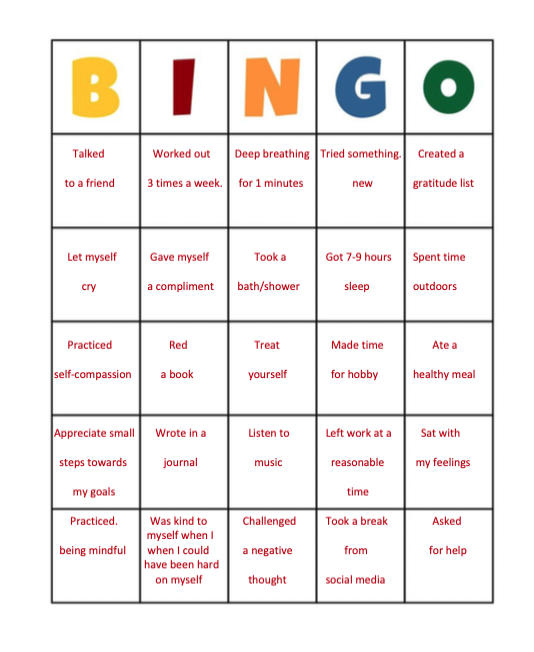
This month we’re focusing on self-care in my group. To support us, I’ve created a self-care bingo. The game’s purpose is regular bingo: mark off the square every time you complete an action on the board. Once you complete a line across, up and down, or diagonally, it’s a win! Award yourself with something nice that lifts your mood.

Screenshot 2022-08-23 at 08.38.35How is this helpful for self-care?

Self-care is something we think is a luxury, but it is essential. You can share from an empty bowl. You can’t spend quality time with your family or friends if your batteries need to be refilled. Maybe you want to be more resilient, relaxed, and spend more time with your loved ones. But you can’t just rebuild your habits from one day to another. Small steps are sustainable. The less is more. Every day focus on just one action on the board.

If you liked this and want to learn some new techniques, please join:

https://www.facebook.com/groups/5petalscoachingwitheva